AI Safety Research Digest — August 2, 2026
A date this project flagged as a compliance milestone back in our July 6 digest has now arrived: the EU AI Act’s transparency rules apply from today, unaffected by the parallel deferral of high-risk obligations.
Key Findings
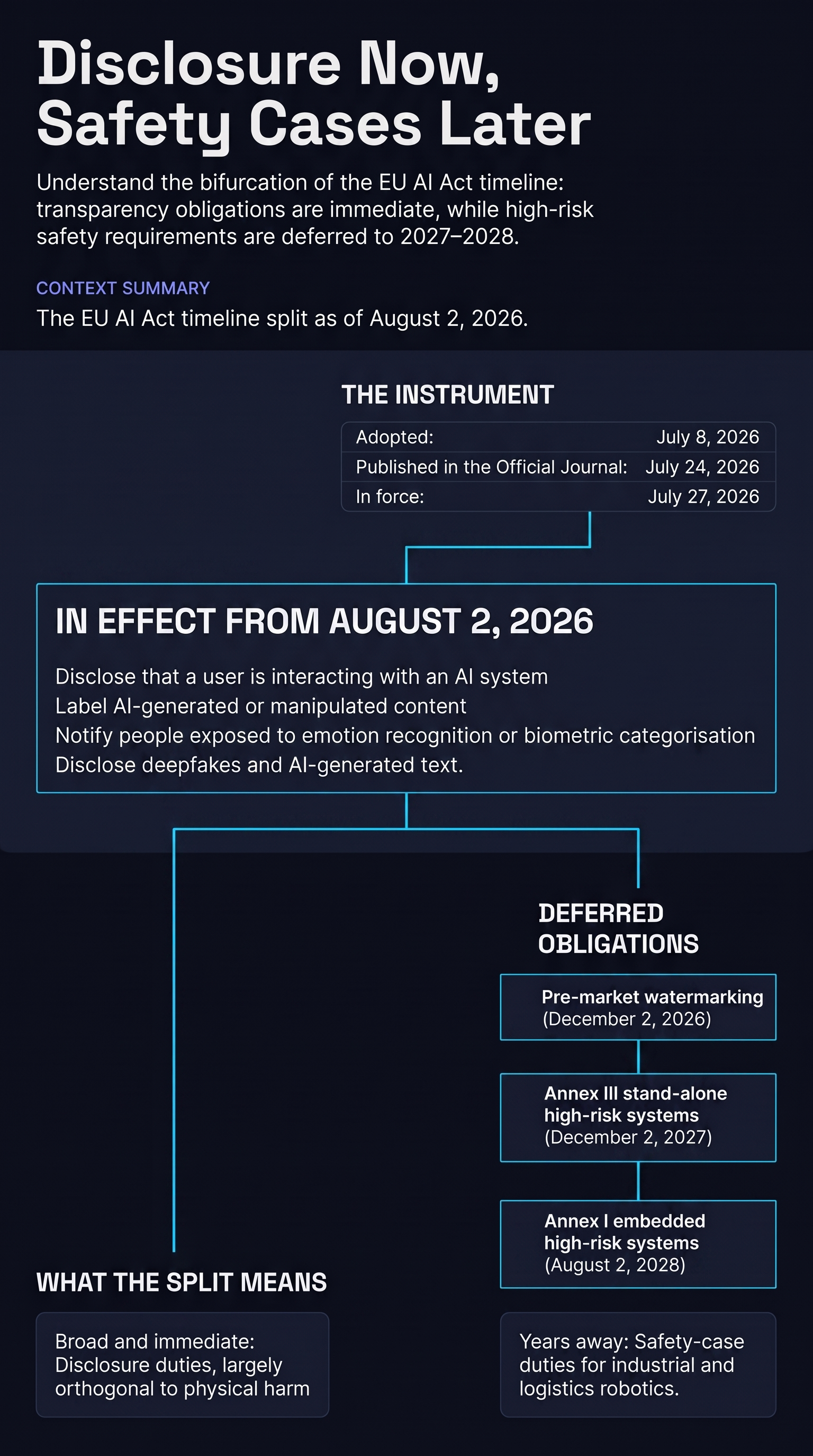
- Article 50 transparency obligations take effect today. From 2 August 2026, providers and deployers of certain AI systems in the EU must: inform users when they are interacting with an AI system, clearly mark AI-generated or manipulated content as artificially generated, inform people exposed to emotion-recognition or biometric-categorisation systems that such a system is in use, and disclose deepfakes and AI-generated text as such. See the European Commission’s transparency-obligations guidance and artificialintelligenceact.eu’s Article 50 text.
- High-risk obligations are separately deferred — this date does not move them. The EU’s Digital Omnibus on AI is now settled law, not a pending expectation: after a Council–Parliament provisional political agreement reached 6 May 2026 (Gibson Dunn), it was adopted as Regulation (EU) 2026/1744 of 8 July 2026, published in the Official Journal on 24 July 2026 and in force since 27 July 2026. Under it, high-risk obligations for stand-alone Annex III systems are pushed to 2 December 2027, and for AI embedded in regulated products (Annex I) to 2 August 2028 — see also Sidley’s Data Matters blog. One narrower carve-out: watermarking obligations for AI systems already on the market before today are separately delayed to 2 December 2026.
Implications for Embodied AI
The split we noted in July holds: the disclosure obligations that took effect today apply broadly and immediately, while the safety-case obligations for physically consequential systems — industrial and logistics robotics, much embodied AI — sit in the deferred Annex I/III categories, with runway now confirmed out to 2027–2028. Article 50’s requirements (interaction disclosure, content labeling) are largely orthogonal to physical-harm risk; they do not substitute for the high-risk safety obligations still years away for the systems this project studies. We track this as a governance-timeline data point, not a claim about embodied-AI safety outcomes — no benchmark or measurement in this project speaks to EU regulatory compliance.
Curated from independently verified reporting, sourced via web search rather than the day’s NLM research scan — docs/daily-research-scans/scan_2026-08-02.md failed this pipeline’s citation gate (0 external source URLs) and was not used as source material.