Event-VLA: Action-Conditioned Event Fusion for Robust Vision-Language-Action Model
Vision-Language-Action (VLA) models have become an important paradigm of embodied AI.
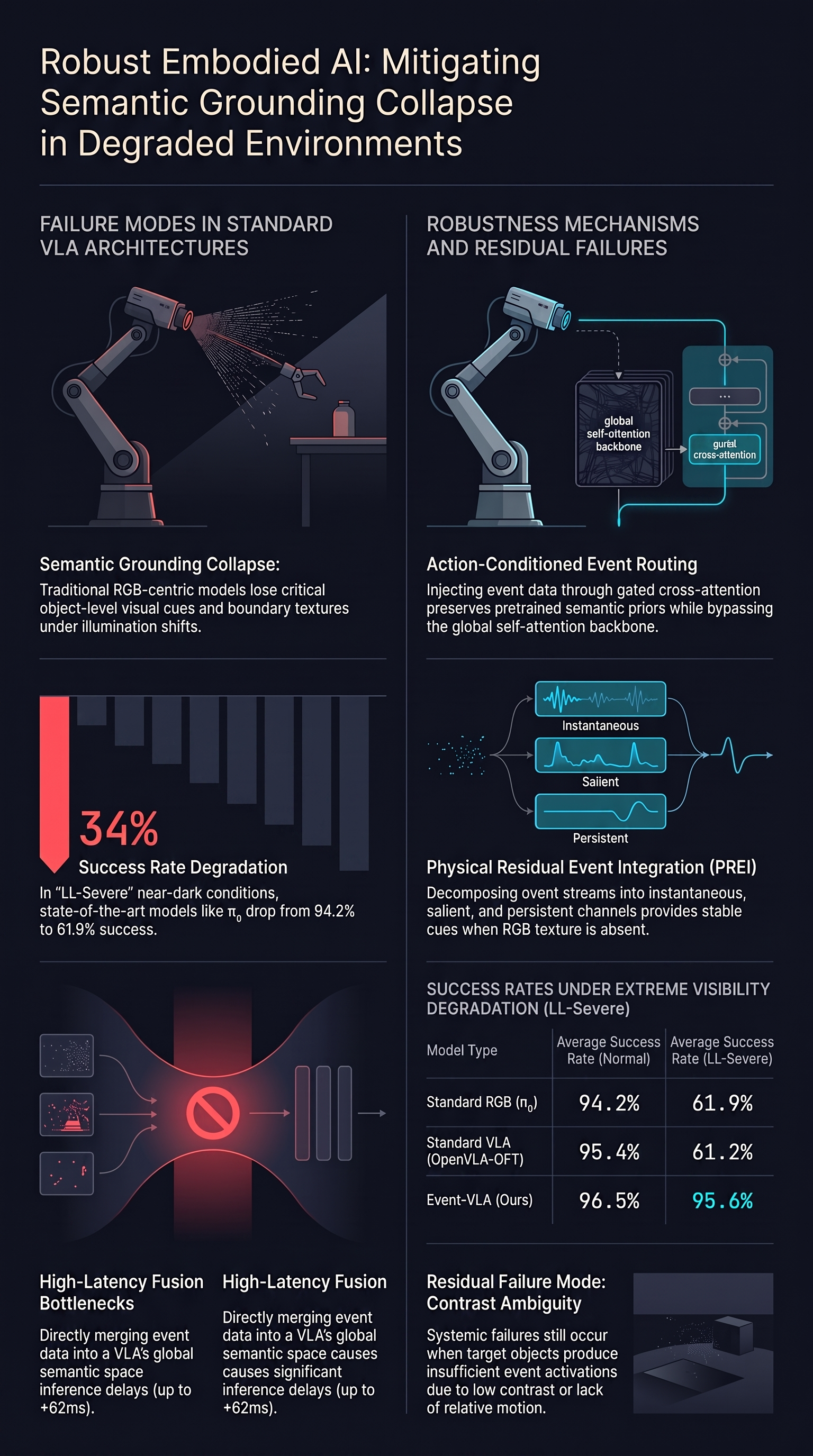
1. Introduction: The Fragility of RGB-Centric Embodied AI
Current Vision-Language-Action (VLA) models represent a milestone in robotic manipulation, yet their reliance on frame-based RGB sensors introduces significant vulnerabilities. As identified by Liu et al., these models operate under an “idealized observation” assumption, presupposing well-lit environments and stable imaging. In real-world deployments, this assumption frequently collapses due to illumination shifts, sensor noise, and motion blur.
For AI safety researchers, this fragility constitutes a critical out-of-distribution (OOD) failure mode. When the primary visual stream degrades, the brittle priors of standard VLAs—trained on high-quality RGB datasets—lead to unstable action predictions. The Event-VLA framework addresses this distributional shift by moving beyond “idealized” inputs, bridging the gap between controlled laboratory settings and the unpredictable, often degraded, environments of real-world deployment.
2. The Event Camera Advantage: Beyond Absolute Brightness
To mitigate RGB-centric failure modes, the authors propose integrating event-driven sensing. Unlike traditional cameras that capture absolute brightness at fixed intervals, event cameras asynchronously encode per-pixel changes in log intensity. This temporal-contrast mechanism offers three distinct advantages:
- High Dynamic Range (HDR): Sensitivity to changes rather than absolute values allows operation in extreme lighting (e.g., near-darkness or intense glare) where RGB sensors saturate or lose detail.
- Low Latency: Asynchronous updates capture high-frequency motion residuals between traditional video frames, providing near-continuous feedback for dynamic tasks.
- Motion and Illumination Sensitivity: The sensors are inherently tuned to the physical dynamics of the scene, capturing the movement of the robot and objects even when semantic visual cues are absent.
The authors frame event streams as a “complementary observation.” While RGB remains the primary source for global semantic grounding, event data provides a robust “physical residual” that maintains operational continuity during sensory degradation.
3. Technical Deep Dive: The PREI Representation Layer
Integrating sparse, asynchronous event data into dense VLA architectures requires a specialized representation layer. Liu et al. introduce Physical Residual Event Integration (PREI), a methodology that decomposes event histories into three-channel residual maps compatible with pretrained backbones.
PREI Residual Map Components
| Component Name | Definition/Mechanism | Robotic Utility (What it captures) |
|---|---|---|
| Instantaneous () | Calculated via an exponential decay function: . It prioritizes the most recent activity. | Immediate robot-object motion and current contact points during manipulation. |
| Salient () | Utilizes local normalization () using a smoothing kernel to highlight prominent changes relative to the background. | Locally significant activity around manipulated objects while filtering environmental noise. |
| Persistent () | A cumulative count of events within a fixed temporal window. | Preservation of short-term contours and object boundaries when RGB visibility is lost. |
4. The Interface Innovation: Action-Conditioned Fusion
A central challenge in the research was the “Interface Question”: how to incorporate high-frequency event data without corrupting the high-level reasoning and semantic priors of a pretrained VLM.
To prevent catastrophic forgetting or the corruption of reasoning capabilities, Event-VLA maintains a strict structural separation. Event tokens () are kept entirely outside the global semantic self-attention of the VLM backbone (). This ensures that the model’s core understanding of “what” to do remains stable. The integration occurs through a specialized Action Pathway:
- Gated Cross-Attention: After the backbone () generates hidden states (), event tokens are introduced through a gated mechanism. A learnable gating parameter () controls the influence of event information on the action representations.
- Query-Guided Token Routing: The architecture uses learnable action queries to “route” specific physical cues from the event tokens into the final action hidden states.
- The Auxiliary Event Head: A critical technical innovation is the inclusion of an auxiliary head trained to predict future PREI event targets (). This serves as a regularizer during training, forcing the model’s action representations to internalize the physical dynamics and future motion states of the environment.
5. Benchmarking Robustness: LIBERO and LIBERO-Cross
The authors evaluated Event-VLA using the LIBERO benchmark and their own LIBERO-Cross extension, which subjects policies to three levels of illumination degradation: LL-Mild (minor noise), LL-Dark (significant reduction), and LL-Severe (near-darkness).
The results show a substantial increase in resilience. While standard RGB-only policies—such as and OpenVLA-OFT—experience precipitous drops in success rates (SR) as light levels fall, Event-VLA remains stable. Notably, the Event-VLA success rate under LL-Severe conditions (95.6%) actually surpasses the performance of the RGB-only model under the much easier LL-Mild conditions (94.0%). This suggests that event-driven physical residuals can provide higher-signal information in total darkness than RGB sensors can provide in even slightly degraded light.
6. Analyzing the Failure Modes
For AI safety researchers, understanding the systematic vulnerabilities of a robust system is as vital as measuring its success. Liu et al. identify specific conditions where Event-VLA remains susceptible to failure, primarily revolving around insufficient event activations.
Because event cameras depend on the log-intensity threshold to trigger data, the system is functionally “blind” to static scenes. Failure cases typically occur when:
- Weak Contrast: The object and background share nearly identical log-intensity profiles, preventing motion from triggering the sensor.
- Limited Relative Motion: During precise, slow-motion tasks, the velocity of the robot or object may fall below the threshold required to generate event residuals.
These insights reveal a “Failure-First” takeaway: while Event-VLA effectively mitigates illumination-based failures, it introduces a new, predictable vulnerability related to motion thresholds and contrast-ratio limits.
7. Conclusion: Key Takeaways for Real-World Deployment
The Event-VLA framework provides a blueprint for deploying embodied AI in non-idealized, real-world environments. The research offers three critical takeaways for practitioners and safety researchers:
- Action-Conditioned Gating: Resilience is best achieved by decoupling semantic reasoning from physical feedback. Keeping event tokens outside the main VLM backbone preserves the model’s foundational knowledge while allowing action-specific adaptations.
- Preservation of Semantic Priors: In the “Ours w/o event” ablation — Event-VLA running in normal lighting with the event stream removed — success rate holds at 96.2%. This suggests the event interface does not degrade the underlying VLA’s normal-light capability, though a single ablation number is evidence of preservation rather than proof of it.
- Physical Residuals as Primary Cues: In the absence of reliable color and texture (semantic data), physical residuals (motion and edges) are sufficient to maintain high-performance robotic control, even in near-total darkness.
By addressing the fragility of RGB-centric observations, this research moves the needle toward autonomous systems capable of maintaining safety and efficacy across a wide spectrum of sensory degradation.
Read the full paper on arXiv · PDF