Towards Robustness against Typographic Attack with Training-free Concept Localization
Models trained via Contrastive Language-Image Pretraining (CLIP) serve as the foundational vision encoders for most modern Large Vision Language Models (LVLMs).
1. The Typographic Vulnerability: When AI Reads Too Literally
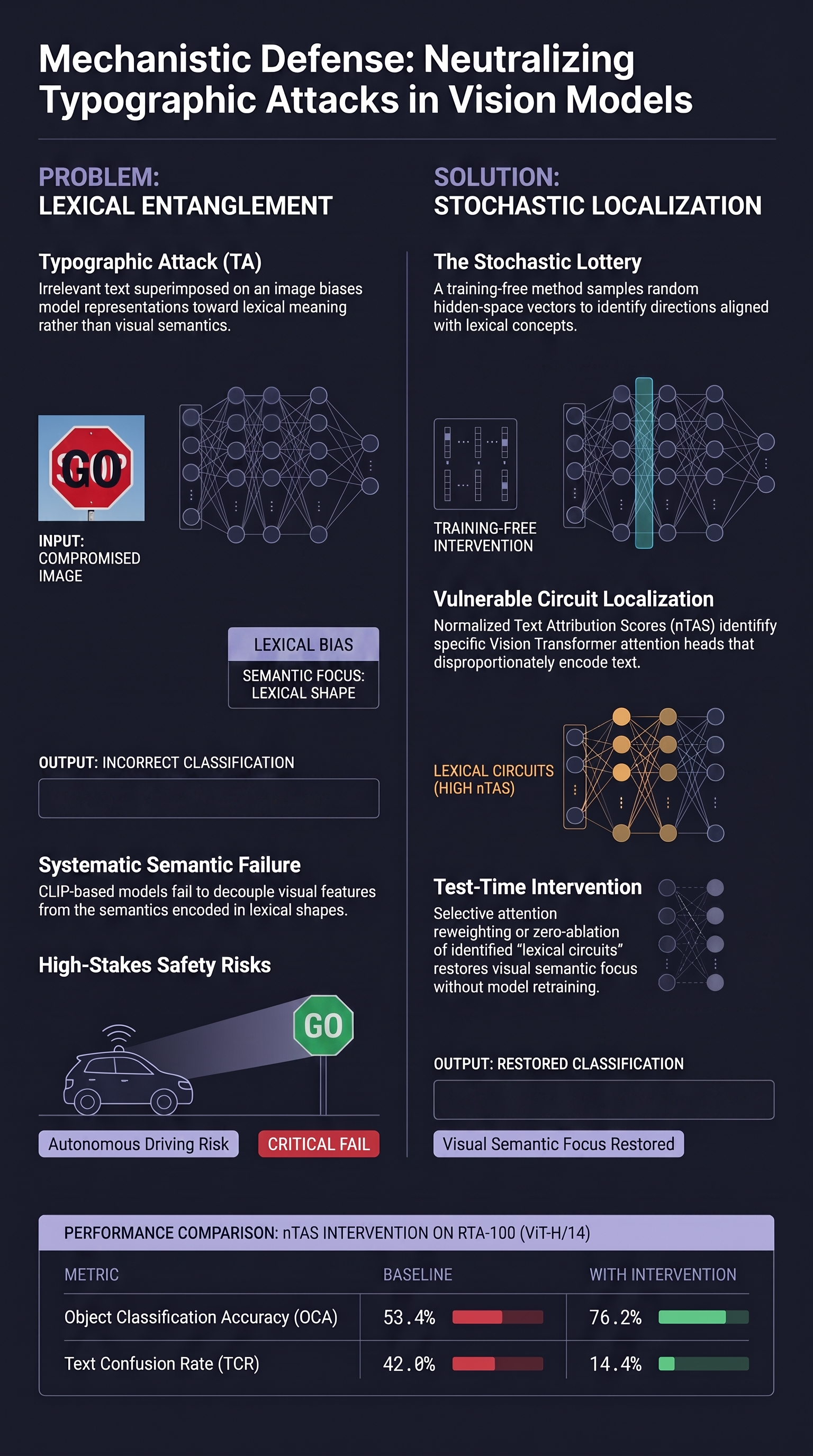
A critical failure mode in modern computer vision occurs when irrelevant text appearing within an image biases the model’s representation toward lexical meaning rather than visual semantics. Known as a “Typographic Attack” (TA), this vulnerability is vividly demonstrated when a Vision Transformer (ViT) classifies an image of a cat as a “Goose” simply because the word “Goose” is superimposed on the subject. From a failure-first safety perspective, this is not a random error but a specific instance of “feature entanglement.” According to the research by Liu et al., the model fails because it cannot decouple the visual features of the animal from the semantics encoded in the lexical shapes of the letters.
For safety-sensitive applications like autonomous driving, such failures are catastrophic; a vehicle’s perception system might misinterpret a stop sign or a road hazard if deceptive text—such as a billboard or a sticker—is present in the environment. The authors identify that these vulnerabilities are not distributed uniformly across the model’s architecture. Instead, the research demonstrates that these failure modes are mechanistically localized within specific “typographic reading circuits” in the ViT encoder. By treating the model not as a black box but as a computational graph with identifiable “vulnerable nodes,” the authors show that it is possible to secure these systems without the need for intensive retraining.
2. Deconstructing the Vision Transformer (ViT) Bottleneck
Modern Large Vision-Language Models (LVLMs) typically rely on Vision Transformers trained via Contrastive Language-Image Pretraining (CLIP). These models utilize Multi-Head Self-Attention (MHSA) to align visual patches with linguistic concepts. While highly capable, the internal mechanisms that prioritize text over visual data have historically been difficult to interpret. The theoretical foundation for the authors’ investigation into these mechanisms is the Linear Representation Hypothesis.
The Linear Representation Hypothesis
This hypothesis posits that latent representations within a neural network can be interpreted as linear combinations of concept directions. In this view, high-dimensional hidden spaces are a superposition of distinct, identifiable vectors representing specific semantic or lexical features.
By adopting this perspective, the research moves beyond macro-level layer analysis to probe how individual visual patches interact and where lexical “interference” originates within the MHSA bottleneck.
3. The “Stochastic Lottery”: A Training-Free Approach to Concept Mining
To identify the specific vectors responsible for typographic vulnerability, the authors propose a novel mechanistic interpretability method called the “Stochastic Lottery.” This approach is rooted in the Lottery Ticket Hypothesis, suggesting that within the vast hidden space, there exists a sparse subset of sampled vectors that happen to align with the target lexical concepts. Unlike traditional methods like Sparse Dictionary Learning (SDL), which require computationally expensive and data-intensive training, this method uses random sampling to find concept directions.
The mathematical logic behind the “Stochastic Lottery” follows a rigorous three-step process:
- Stochastic Sampling: Researchers sample random hidden space vectors () to act as “pseudo-concept” probes, treating them as linear probe initializations.
- The Subspace Advantage: Sampling occurs within the lower-dimensional subspace (the MHSA bottleneck) rather than the global residual stream. Using concentration of measure and Gaussian tail bounds, the authors demonstrate that operating in this smaller space filters out “on-concept” signals from the “null space” of the individual head. This significantly reduces “polysemantic interference”—the noise created when multiple concepts are packed into the same vector.
- Identifying “Winning Tickets”: By pushing head-excluded concepts into the null space, the probability of a “lottery hit” increases. These “winning tickets” are the sampled vectors that align with lexical (textual) rather than semantic (visual) concepts, allowing researchers to trace how text-based information propagates through the network.
4. Localizing the Vulnerability: The nTAS Score
Once concept vectors are identified, the research utilizes a “normalized Text Attribution Score” (nTAS) to quantify the vulnerability of specific modules. Unlike simple attention-map visualizations, this is a gradient-based attribution method. The nTAS is defined by the partial derivative of the concept strength with respect to the pre-softmax logit, ensuring a more faithful representation of how information flows through the routing circuit.
The qualitative findings of the research reveal distinct patterns in the model’s internal behavior:
- High nTAS Heads: These modules exhibit positive gradient attribution maps that concentrate almost exclusively on the “pixel-level edit area” where text is located. In images featuring “Boots,” “Firming Lotion,” or “Savage” text, high nTAS heads highlight the typographic characters while almost entirely ignoring the physical objects.
- Low nTAS Heads: These modules produce diffuse or object-oriented maps, focusing on the visual semantics—the actual shape of the bottle or footwear—rather than the text.
5. Mechanistic Intervention: Reweighting and Ablation
Identifying these localized “typographic reading circuits” allows for precise, “test-time” interventions to restore robustness. The authors propose two primary training-free methods to “mute” these vulnerable nodes:
- Attention Reweighting: For object classification in CLIP backbones, the model suppresses information from textual patch tokens. By adjusting the influence of patch tokens relative to the class token (
), the model is forced to overlook lexical distractors. - Zero Ablation: For LVLMs that lack a dedicated class token (such as InternVL or Qwen), the authors replace the output of the identified vulnerable modules with a zero vector.
These interventions are highly efficient, requiring no additional training and incurring near-zero computational overhead at test-time.
6. Results: Robustness Across Scales and Backbones
The authors evaluated their approach across a range of ViT scales, demonstrating that mechanistic interventions consistently improved Object Classification Accuracy (OCA) and significantly reduced the Text Confusion Rate (TCR)—the rate at which a model is successfully fooled by text.
Table: Robustness Improvements Across ViT Scales (Selected Data)
| Model Backbone | Baseline OCA (↑) | Intervened OCA (↑) | Baseline TCR (↓) | Intervened TCR (↓) |
|---|---|---|---|---|
| ViT-B/16 | 56.3% | 68.7% | 30.8% | 12.6% |
| ViT-L/14 | 54.6% | 68.9% | 39.0% | 21.2% |
| ViT-H/14 | 53.4% | 76.2% | 42.0% | 14.4% |
| ViT-bigG/14 | 61.0% | 75.7% | 32.5% | 15.3% |
Data aggregated from RTA-100 and associated typographic attack datasets.
When applied to state-of-the-art LVLMs using the RIO-Bench for Visual Question Answering (VQA), the intervention showed significant efficacy, though results varied across backbones:
- Qwen3-VL-8B: Showed a significant overall average gain () of +1.58% in VQA accuracy under typographic interference.
- Gemma3-12B: Achieved an overall gain of +1.53%, with resilient performance across Easy, Medium, and Hard TA subsets.
- InternVL3.5-14B: While the method remained generalizable, this backbone saw only a “marginal” overall improvement of +0.01%, even exhibiting a slight negative gain (-0.28) in the Medium category.
Crucially, the research reports a “minimal accuracy trade-off” of less than 1% on clean, non-attacked images. This performance indicates that targeted mechanistic intervention is more efficient than supervised tuning, which often results in much higher degradation of a model’s general capabilities.
7. Conclusion: The Future of Mechanistic AI Safety
The research by Liu et al. provides a critical framework for moving AI safety from reactive, black-box defense to proactive, surgical intervention. The study offers three primary takeaways:
- Vulnerability is Mechanistically Localized: Typographic weaknesses are not inherent to the entire model’s weights but are found within specific, identifiable “reading circuits.”
- The Stochastic Lottery is a Viable Tool: Random sampling within the MHSA bottleneck is an effective, low-cost alternative to expensive dictionary learning for concept discovery.
- Training-Free Robustness: Targeted interventions can significantly boost the robustness of state-of-the-art models without sacrificing general performance or requiring new training data.
This work advances the frontier of AI safety by demonstrating that understanding the internal “logic” of a model is the most direct path to securing it against systematic, high-stakes failures.
Read the full paper on arXiv · PDF