Physically Real-time Infrared Attack against Optical Flow Estimation Networks
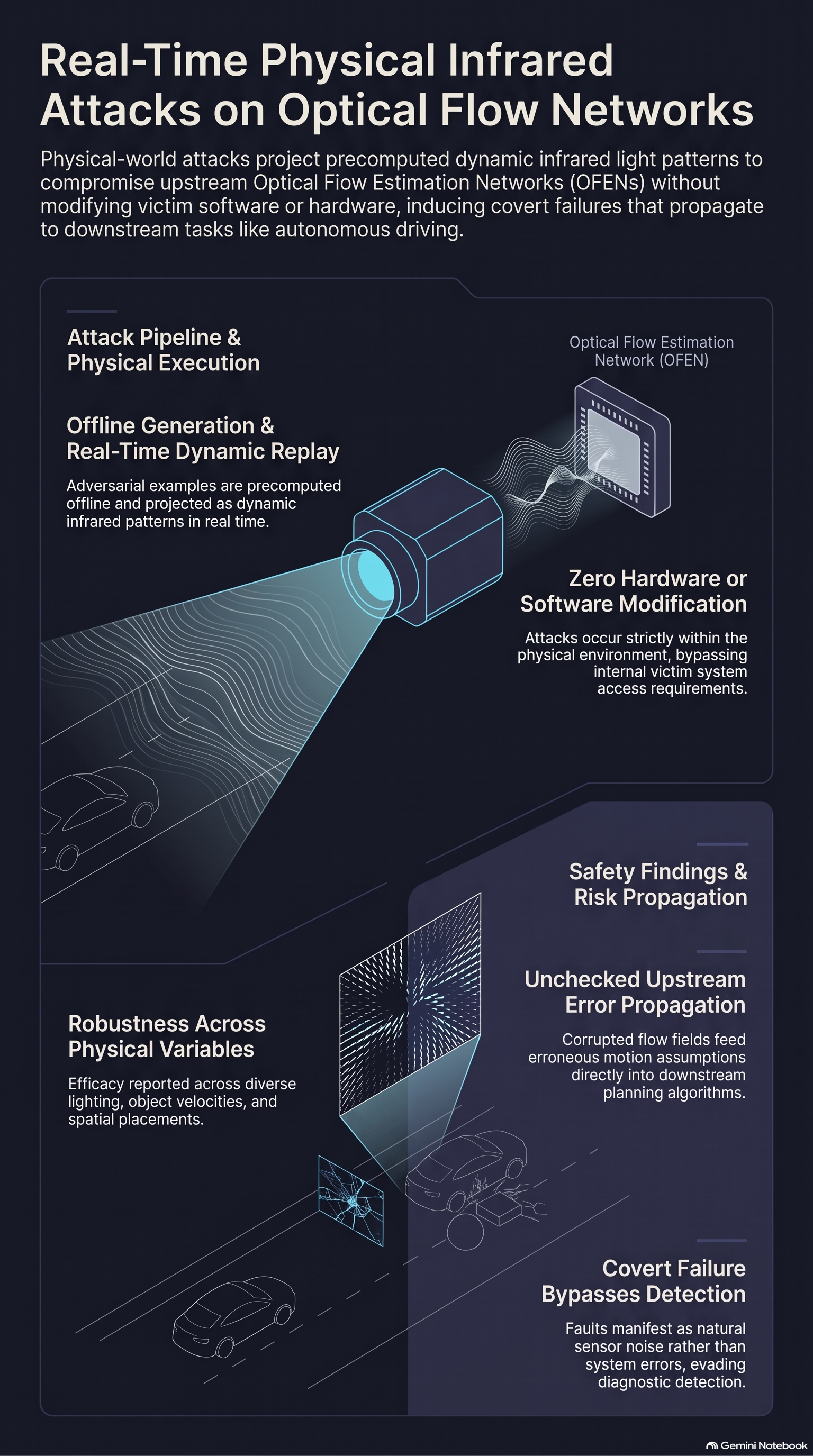
The authors precompute a large pool of adversarial examples against optical flow estimation networks and select and replay them in real time as infrared light patterns projected into the physical...
1. Introduction: The Stealthy Threat to Upstream Perception
Optical Flow Estimation Networks (OFENs) serve as foundational upstream perception models in modern autonomous architectures. These networks calculate pixel-level relative motion across consecutive visual frames, producing velocity vectors that downstream modules rely upon for critical tasks such as path planning, object tracking, autonomous driving, and motion detection. Because downstream decision-making pipelines implicitly trust the integrity of these motion fields, vulnerabilities in upstream flow estimation can induce cascading failures throughout the entire autonomy stack.
In a research paper titled “Physically Real-time Infrared Attack against Optical Flow Estimation Networks”, authors Shen You, Wei Jiang, Jiarui Liu, Yijian Ye, Qiuzhen Lin, Xiangtao Li, and Ka-Chun Wong (arXiv:2607.26651) demonstrate a physical-world, real-time adversarial attack against OFENs. By projecting dynamic infrared light patterns into the physical scene, the authors demonstrate how physical environmental perturbations can manipulate upstream visual flow fields without requiring software access or hardware modifications to the target platform.
“Optical flow estimation networks are upstream perception models whose outputs are consumed directly by downstream tasks such as autonomous driving and motion detection, so a corrupted flow field propagates into whatever the pipeline computes next.”
2. Deconstructing the Attack Pipeline: From Offline Precomputation to Physical Projection
Traditional digital-to-physical adversarial attacks—such as printed adversarial patches—frequently experience significant decay in physical effectiveness. This loss of potency occurs because static physical artifacts cannot adapt to environmental shifts, rigid spatial angles, distance variations, or changing ambient lighting. To overcome this limitation, Shen You et al. designed a two-phase attack pipeline that decouples complex optimization from real-time execution, enabling dynamic adaptation to active scene dynamics.
+--------------------------------------------------------+
| 1. Offline Precomputation Phase                        |
| Precompute large pool of digital adversarial examples  |
+--------------------------------------------------------+
                           |
                           v
+--------------------------------------------------------+
| 2. Real-Time Processing Phase                          |
| Select & compute optimal AEs based on active scene    |
+--------------------------------------------------------+
                           |
                           v
+--------------------------------------------------------+
| 3. Dynamic Physical Projection                         |
| Project infrared light patterns into the physical scene|
+--------------------------------------------------------+
The attack workflow proceeds through three integrated stages:
- Offline Precomputation Phase: The authors generate and aggregate a diverse pool of adversarial examples (AEs) targeted against optical flow estimation networks prior to deployment, performing the heavy optimization offline.
- Real-Time Processing Phase: During execution, the system evaluates the target environment and selects or computes the optimal adversarial pattern from the precomputed pool in real time based on active scene context.
- Dynamic Physical Projection: The selected patterns are projected into the physical space as modulated infrared light, continuously adjusting to scene changes and maintaining attack potency where static physical perturbations decay.
A defining characteristic of this methodology is that it requires zero modifications to the victim system’s software, firmware, or hardware. By interacting exclusively through the optical medium via light emission, the attack operates entirely outside the platform’s security perimeter. This non-invasive interaction creates severe challenges for standard defensive frameworks, as the target hardware receives external light indistinguishable from environmental inputs.
3. Physical-World Efficacy and Testing Scope
Because physical adversarial attacks operate in unconstrained operational environments, evaluating their impact requires analyzing model performance across physical parameters rather than relying on static digital perturbation metrics (-norms). The authors evaluated the attack’s physical resilience against multiple environmental variables to measure its impact on optical flow field accuracy.
In their reported findings, Shen You et al. focus on qualitative efficacy—demonstrating that projected infrared patterns systematically impair the network’s ability to calculate accurate motion vectors. The authors do not report a specific numerical attack success percentage or quantitative error rate, framing their evaluation around qualitative estimation degradation under varying operational conditions.
| Experimental Variables Tested | Reported Qualitative Impacts |
|---|---|
| Diverse Lighting Conditions | Compromises optical flow estimation stability across differing ambient light environments. |
| Varying Object Motion Velocities | Maintains physical attack effectiveness against targets moving at different speeds. |
| Different Object Placements | Disrupts network output across varied physical orientations and spatial placements in the scene. |
4. Failure-First Safety Analysis: Downstream Error Propagation & Stealth
From an AI safety and red-teaming perspective, the physical infrared attack detailed by Shen You et al. highlights critical structural vulnerabilities in perception pipelines:
- Upstream Propagation: Because optical flow models operate early in the perception sequence, invalid motion vectors pass unverified into subsequent modules. Corrupting the optical flow field induces secondary failures in downstream autonomous driving and tracking systems, causing improper trajectory planning or missed obstacle detections.
- Sensor-Level Stealth: The attack leverages wavelengths in the infrared spectrum (700 nm – 1 mm). CMOS and CCD visual sensors in perception hardware capture these emissions within their spectral sensitivity range, whereas the human visual system remains completely unaware of the projection. This creates a physical covert channel directly into the sensor array.
- System Containment and Incident Response: Because the attack vector relies entirely on emitted light, no binary payloads, memory buffers, or network interfaces are manipulated. Consequently, Endpoint Detection and Response (EDR) tools, software integrity verifiers, and system log monitors fail to generate security alerts. The platform processes the malicious signals as valid physical input, causing safety architectures to misinterpret the operational failure as unmonitored hardware degradation or adverse environmental noise.
5. Key Takeaways for AI Red-Teamers and Researchers
- Upstream perception models represent single points of failure: Adversarial perturbations applied to early-stage flow estimation networks corrupt all dependent downstream decision-making pipelines without requiring direct manipulation of control software.
- Dynamic optical projection overcomes physical transfer decay: Real-time infrared projection bypasses the physical decay limitations inherent to static printed patches by dynamically tailoring light patterns to active scene conditions.
- Non-invasive vectors evade conventional fault detection: Interacting strictly through the physical optical medium prevents digital intrusion detection systems and EDR agents from triggering, leaving security teams blind to active physical attacks.
- Traditional digital robustness benchmarks are insufficient: Evaluating perception resilience requires validating systems against out-of-distribution physical perturbations—such as ambient illumination shifts, object velocity variations, and spatial repositioning—rather than relying solely on -norm bounded digital evaluation suites.
Read the full paper on arXiv · PDF