Practice Makes Policies: Bootstrapping and Consolidating Robotic Capabilities from Zero Human Demonstrations
The authors present HERO, a hierarchical embodied framework that orchestrates heuristic reasoning, exemplar reuse, and reflexive execution to autonomously bootstrap and consolidate closed-loop...
1. Introduction: The Shift to Autonomous Robotic Bootstrapping
In traditional general-purpose robotic manipulation, skill acquisition has predominantly been static. Capabilities are typically trained for specific environments or tasks using pre-collected datasets rather than adaptively evolving through continuous physical interaction. To address this limitation, Li et al. introduced a self-improving framework in their paper, “Practice Makes Policies: Bootstrapping and Consolidating Robotic Capabilities from Zero Human Demonstrations”.
The authors present HERO (a self-improving hierarchical embodied agent), designed to evolve manipulation capabilities autonomously without relying on human demonstrations. Drawing an analogy to how repeated physical practice enables humans to develop muscle memory over time, HERO provides a mechanism for autonomous capability evolution. According to the authors, the framework systematically transforms raw physical interaction experiences into consolidated manipulation skills without human intervention or hand-labeled trajectory supervision.
2. Core Architectural Framework: The HERO Orchestration Engine
HERO structures its capability evolution by organizing three distinct architectural pillars into a unified orchestration engine. The framework continuously expands and dynamically schedules these manipulation capabilities based on the robot’s current stage of experience accumulation and specific task execution requirements.
| Architectural Component | Operational Role | Contribution to Zero-Demonstration Bootstrapping |
|---|---|---|
| Heuristic Reasoning | Drives high-level strategy and initial task execution choices. | Enables initial interaction and experience bootstrapping in open-world environments without pre-existing human trajectories. |
| Exemplar Reuse | Facilitates experience transfer across physical interactions. | Accelerates skill acquisition by enabling the rapid accumulation of reusable behaviors from past successful trials. |
| Reflexive Execution | Implements closed-loop visuomotor policies for direct action. | Consolidates recurring physical interaction experiences into fast, efficient, closed-loop execution. |
3. Data Collection & Capability Consolidation Pipeline
HERO tightly couples autonomous data collection directly with task execution. The pipeline systematically transitions raw physical interaction into reflexive execution across several stages:
- Autonomous Interaction Bootstrapping: The agent executes initial tasks in open-world environments using high-level heuristic reasoning, capturing raw physical interaction data from zero human demonstrations.
- Behavior Accumulation via Exemplar Transfer: The system leverages exemplar reuse to transfer physical interaction experiences across tasks, rapidly accumulating a library of reusable behaviors.
- Progressive Policy Consolidation: Over time, recurring physical interactions and accumulated behaviors are systematically consolidated into efficient closed-loop visuomotor policies without human supervision.
- Dynamic Capability Scheduling: HERO evaluates its stage of experience accumulation alongside real-time task requirements to dynamically schedule control between heuristic reasoning, exemplar retrieval, and reflexive execution.
The authors report that empirical benchmarks across diverse manipulation tasks demonstrate a substantial reduction in human intervention during robotic data collection while maintaining robust manipulation performance. However, it should be noted that while the authors assert a substantial empirical reduction, exact quantitative benchmarks (such as precise percentage reductions in intervention or specific task success rates) were omitted from the abstract summary and require verification against full experimental logs.
4. Failure-First Perspective: Safety Risks and Failure Modes
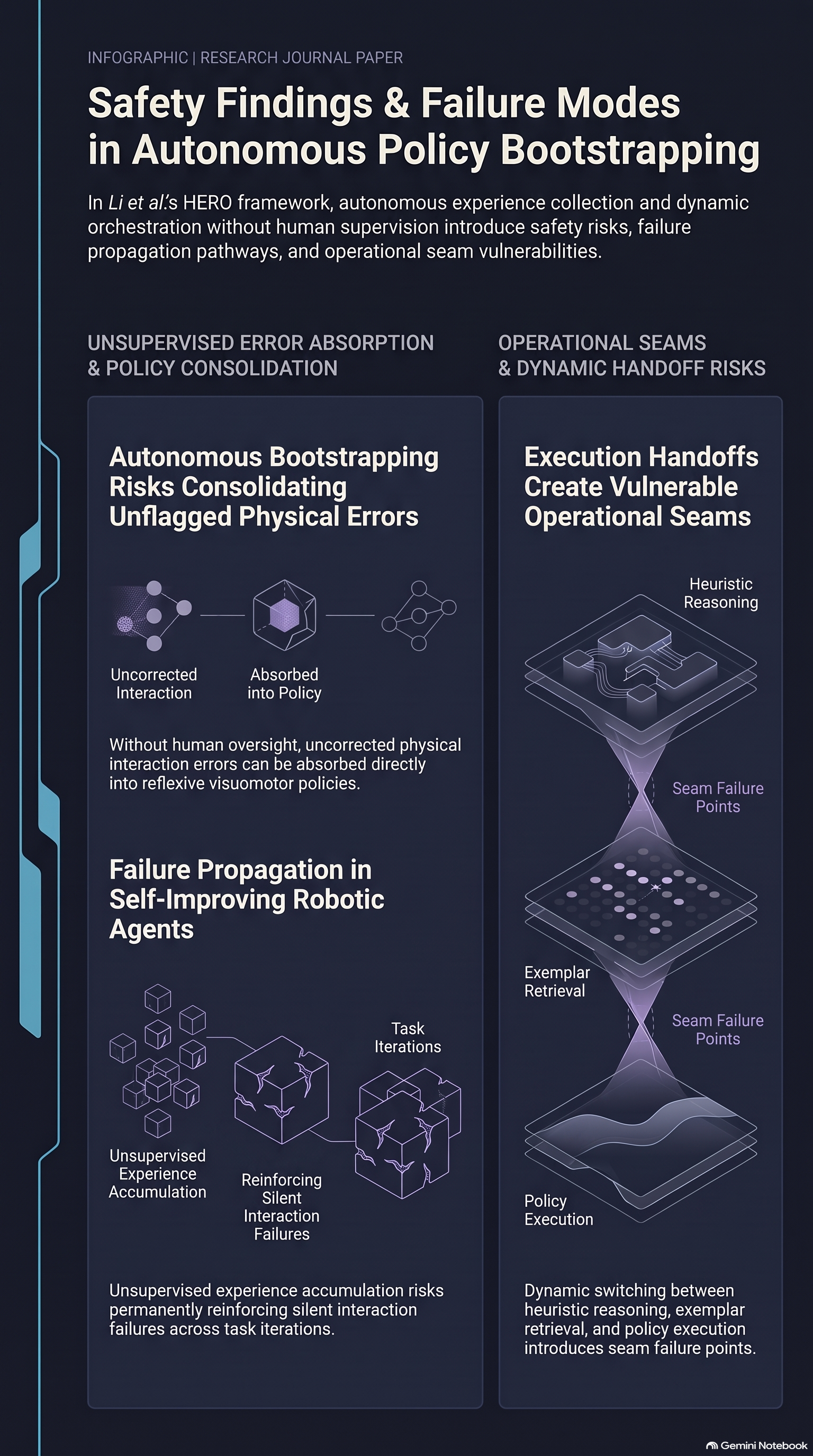
Analyzing HERO from an AI safety and red-teaming perspective highlights specific failure propagation vectors inherent to unsupervised, self-improving embodied architectures.
Unflagged Physical Error Propagation
Because HERO bootstraps policies from zero human demonstrations and operates without real-time human supervision, the system risks reinforcing physical interaction errors. Closed-loop visuomotor policies learn mapping directly from raw sensor inputs (such as visual camera streams) to low-level motor commands. If physical interaction failures or subtle execution mistakes—such as misaligned gripping, micro-slippage, or uncorrected structural instability—occur during autonomous experience collection without being flagged or filtered, the agent treats these corrupted interaction trajectories as valid training targets. During the policy consolidation phase, these unflagged physical mistakes are distilled directly into the low-level policy, institutionalizing latent physical errors into automated, habitual execution.
Handoff Failures at Operational Seams
HERO relies on dynamic scheduling to switch control between high-level heuristic reasoning, exemplar retrieval, and low-level reflexive visuomotor execution. Switching between these modules creates operational seams across execution layers. High-level heuristic reasoning operates at a lower temporal frequency, generating abstract spatial goal states and task plans. In contrast, reflexive visuomotor control operates as a high-frequency, closed-loop execution module. Transitioning control across these layers introduces temporal latency and state-estimation discrepancies, creating high-risk boundary windows where handoff failures—such as trajectory discontinuities or spatial misalignments—can trigger physical instability or task execution failures.
5. Summary of Key Takeaways
- Zero-Demonstration Capability Evolution: Li et al. introduce HERO, a hierarchical agent capable of autonomously bootstrapping and consolidating closed-loop visuomotor policies without relying on human demonstrations.
- Tripartite Architecture: The framework integrates heuristic reasoning, exemplar reuse, and reflexive execution into a dynamic orchestration engine that adapts to different stages of experience accumulation.
- Reduced Human Supervision: The authors report benchmark results showing that HERO substantially reduces the need for human intervention during physical data collection, though specific numerical metrics require verification against full experimental logs.
- Risk of Unflagged Error Distillation: In the absence of human supervision during experience collection, unflagged physical execution errors (e.g., misaligned grips or slippage) risk being distilled directly into low-level visuomotor policies as target behaviors.
- Vulnerabilities at Operational Seams: Dynamic handoffs between low-frequency heuristic reasoning and high-frequency reflexive control create boundary windows susceptible to latency, state-estimation discrepancies, and handoff failures.
Read the full paper on arXiv · PDF