RoboBRIDGE: A Modular Framework for Bridging Policies to Robust Real-World Robotic Agents
The paper introduces RoboBRIDGE, a modular five-part orchestration framework that wraps pretrained Vision-Language-Action policies with failure detection, hierarchical recovery, asynchronous...
1. Introduction: The Agentic Gap in Vision-Language-Action Models
Pretrained Vision-Language-Action (VLA) models—such as OpenVLA, , GR00T-N1.5, and SmolVLA—have demonstrated remarkable capabilities in mapping visual inputs and natural language instructions directly to low-level motor commands. However, as Sihyung Yoon et al. argue in their paper accepted to IROS 2026, a highly capable action predictor does not inherently constitute an autonomous robotic agent.
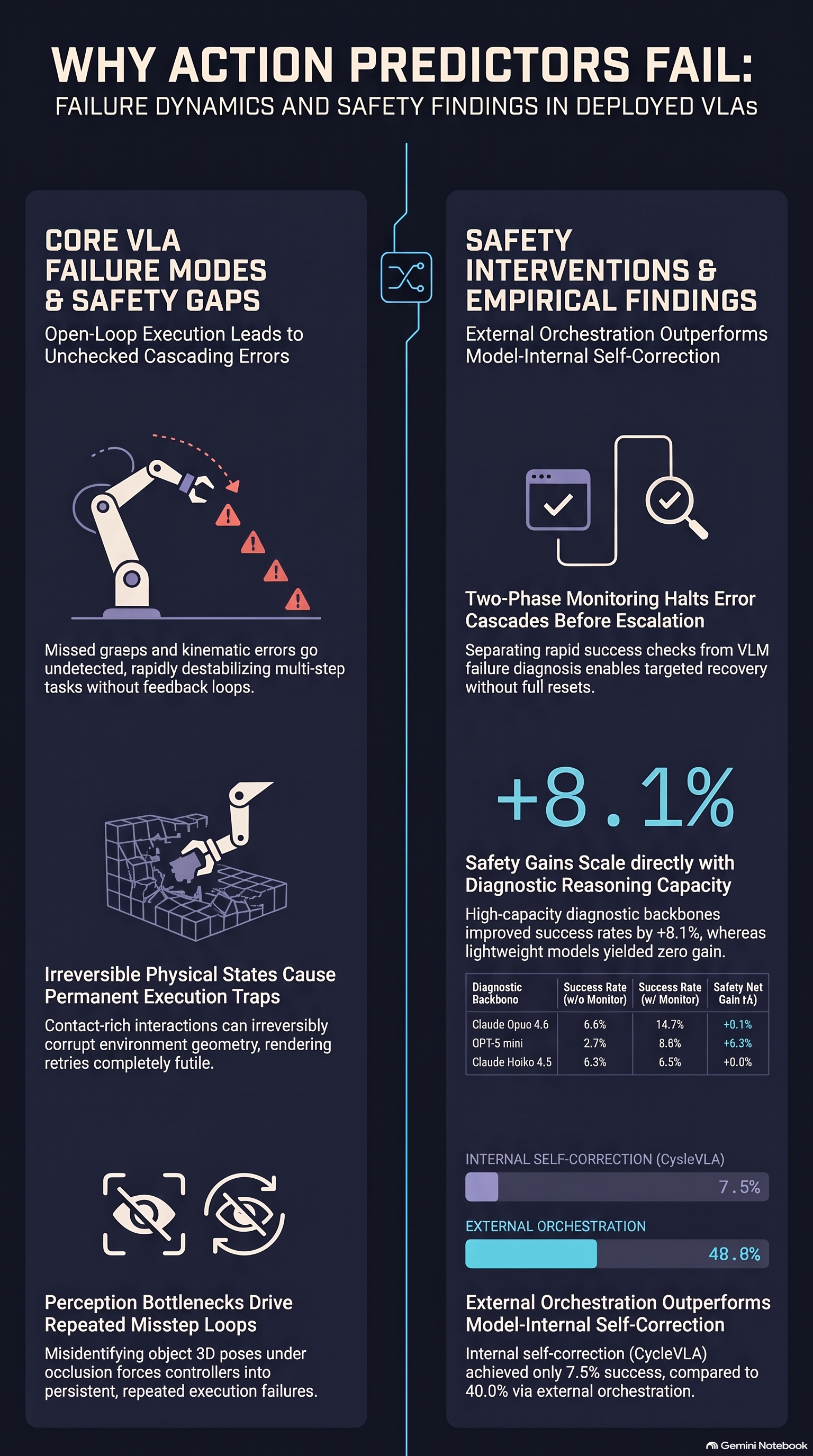
When deployed as monolithic, open-loop forward passes, current VLA models exhibit an “agentic gap.” They operate without native mechanisms to detect execution failures, maintain logical consistency across long task horizons, or adapt robustly to domain shifts in observations, tasks, or hardware embodiments. In open-loop execution, a single missed grasp goes unnoticed, compounding spatial trajectory errors derail multi-step manipulation sequences, and subtle changes in visual background or kinematic configuration cause policy performance to degrade sharply.
This distinction mirrors the architectural evolution of Large Language Models (LLMs). Raw LLMs did not evolve into functional, autonomous software agents through unconstrained parameter scaling alone. Instead, the AI community transformed base language models into agents by surrounding them with orchestration frameworks that manage tool use, long-term memory, planning, and output verification without modifying the base model’s underlying weights.
To address the agentic gap in robotics, Yoon et al. present RoboBRIDGE, a general, policy-agnostic orchestration framework. RoboBRIDGE wraps off-the-shelf action-generating policies—including pretrained VLAs and classical controllers—with coordinated perception, planning, monitoring, and hardware abstraction modules. By providing structured external orchestration rather than requiring foundational model retraining, RoboBRIDGE transforms passive action predictors into robust, closed-loop robotic agents.
2. Deconstructing the Architecture: The Five Coordinated Modules
The RoboBRIDGE framework establishes a modular control stack comprising five specialized, interacting components. This architecture decouples task planning, state estimation, low-level control, and safety monitoring into distinct operational roles.
| Module Name | Core Input / Trigger | Primary Function |
|---|---|---|
| Perceptor | Raw sensory observations () | Converts visual data into an object-centric scene state (3D poses, object identities, and semantic affordances). Runs continuously in an asynchronous thread. |
| Planner | Object-centric state (), Language instruction () | Decomposes complex instructions into an ordered sequence of parameterized primitive skills (); manages reactive replanning upon environment divergence. |
| Controller | Primitive skill (), Context state (), Instruction () | Serves as the pluggable slot for action generation (e.g., VLA with LoRA adapters or classical IK solvers), converting primitives into low-level 7-DoF actions. |
| Robot Interface | Action commands () | Abstracts platform-specific APIs, coordinate frame transformations, kinematic constraints, and safety limits across physical robots and simulators. |
| Monitor | Observations (), Plan context (), Control status | Evaluates execution success asynchronously at ~5Hz and executes a four-tier hierarchical recovery protocol when failures occur. |
                       +-----------------------------------+
                       |        Language Instruction       |
                       +-----------------------------------+
                                         |
                                         v
+------------------+           +-------------------+           +-------------------+
|    Perceptor     | --------> |      Planner      | --------> |    Controller     |
| (Async Perception|           | (Reactive Prims   |           | (VLA + LoRA / IK) |
|   Thread / B)    |           |    Planning)      |           +-------------------+
+------------------+           +-------------------+                     |
         ^                               ^                               v
         |                               |                     +-------------------+
         | (re-perceive)                 | (re-plan)           |  Robot Interface  |
         |                               |                     |  (FCI / RTDE)     |
+--------------------------------------------------+           +-------------------+
|                     Monitor                      |                     |
|  (Phase 1: Success Check -> Phase 2: Diagnosis)  | <-------------------+ (Action, Obs)
+--------------------------------------------------+
As illustrated in the system topology, RoboBRIDGE creates a closed feedback loop around the primary policy. The Perceptor continuously maintains an updated scene representation without blocking execution. The Planner converts language directives into discrete primitives, which the Controller converts into low-level trajectory deltas dispatched through the Robot Interface. Crucially, the Monitor inspects real-world outcomes at each step, signaling the Perceptor, Planner, or Controller to intervene whenever execution diverges from the intended plan.
3. Core Mechanisms Driving Robustness
RoboBRIDGE introduces three core technical mechanisms to ensure closed-loop failure recovery, execution consistency over long task horizons, and domain adaptability.
3.1 Two-Phase Monitoring and Hierarchical Recovery
Continuous deep diagnostic analysis using vision-language models (VLMs) introduces prohibitive computational latency to real-time control loops. To overcome this, Yoon et al. decouple execution monitoring into a two-phase architecture that functions as an external runtime safety enclosure, preventing local errors from cascading into unrecoverable failure states:
-
Phase 1: Lightweight Success Check: A lightweight VLM () operates asynchronously outside the primary control loop at approximately 5Hz. It periodically compares the current sensory observation () against the expected plan context () using a constrained output format that suppresses lengthy chain-of-thought generation to minimize latency: producing a binary success flag () and a confidence score ().
-
Phase 2: Failure Diagnosis & Recovery: If an execution failure is detected with high confidence ( and ), the framework immediately halts physical robot motion and invokes a high-capacity diagnostic VLM (). This diagnostic model identifies the failure root cause and selects a target recovery strategy () along with an explanatory diagnosis ():
The selected recovery target maps directly to specific system modules within a four-tier hierarchical escalation scheme ordered by computational cost:
- Retry: Signals the Controller and Robot Interface directly to re-execute the current primitive skill from its initial state without altering the plan or state representation.
- Regenerate: Signals the Controller to re-invoke motion trajectory generation while retaining the existing task plan and perception state.
- Replan: Signals the Planner to regenerate downstream primitives using the latest cached perception state stored in the asynchronous buffer ().
- Re-perceive: Forces an active synchronous call to the Perceptor () to perform a complete visual re-scan and state re-estimation before triggering the Planner (invoked when object poses or spatial states become invalid or corrupted).
3.2 Reactive Planning with Asynchronous Perception
Conventional robotic pipelines perform perception prior to planning, assuming a static world state throughout execution. In physical manipulation, robot contact and environmental shifts routinely invalidate this assumption. RoboBRIDGE resolves this using a concurrent producer-consumer architecture that decouples perception latency from policy execution:
- Asynchronous Perception Thread: A dedicated perception thread continuously writes the latest scene detection state () into a thread-safe buffer . Crucially, buffer maintains a single-entry overwrite policy—storing only the most recent observation state rather than an accumulating queue—thereby eliminating stale perception latency during execution.
- Divergence-Triggered Replanning: Following the execution of each primitive, the Planner calculates a spatial divergence metric comparing the initial scene state used for planning () against the latest buffered state (): where represents the 3D position of object , is the set of detected objects, denotes the symmetric set difference, and weights object appearance/disappearance relative to positional displacement.
When , a replanning event triggers. The high-level task sequence (e.g., PICK PLACE) is preserved while primitive spatial parameters are instantly updated to match , eliminating stalls while maintaining long-horizon alignment.
3.3 Primitive Skill Fine-Tuning with Dedicated LoRA Adapters
Monolithic VLA models typically generate actions using a single set of network weights across all manipulation phases. To prevent multi-phase task interference and reduce sensitivity to domain shifts, RoboBRIDGE factors complex manipulation into domain-invariant primitive skills:
When a VLA occupies the Controller slot, lightweight Low-Rank Adaptation (LoRA) modules (, rank 128, alpha 256) are attached to the frozen base VLA backbone (). Each adapter is trained exclusively on primitive-filtered demonstration data:
At execution time, the Controller swaps LoRA adapters in-place without reloading base model weights using a two-tier resolver logic:
The active adapter predicts a 7-DoF delta action (translation, rotation, gripper state). The framework executes a two-path dispatch strategy based on kinematic availability:
- IK Target Solving: When an Inverse Kinematics (IK) solver is available, translational deltas update the end-effector pose (), and joint angles are solved directly via .
- Cartesian Velocity Fallback: If the IK solver fails or is unconstrained for the platform, the controller seamlessly falls back to 7-DoF Cartesian velocity control commands:
4. Empirical Evaluation & Benchmark Analysis
Yoon et al. evaluated RoboBRIDGE across simulation suites (LIBERO and RoboCasa) and physical hardware platforms using three VLA backbones: SmolVLA, , and GR00T-N1.5-3B.
4.1 Simulation Performance (LIBERO & RoboCasa)
In simulation experiments, wrapping pretrained VLAs with RoboBRIDGE yielded substantial performance gains without retraining base policy backbones.
-
LIBERO Suite: Evaluated with GR00T-N1.5 across four standardized task suites, RoboBRIDGE increased overall average success from 35.5% (standalone) to 39.7%. Performance improvements were heavily concentrated in long-horizon and complex object manipulation tasks:
- LIBERO-Long: Success increased from 10.6% to 20.0% (+9.4%).
- LIBERO-Object: Success increased from 4.7% to 10.0% (+5.3%).
- LIBERO-Spatial and LIBERO-Goal: Exhibited minor positive gains (72.4% 73.5% and 54.1% 55.3%, respectively), demonstrating that RoboBRIDGE improves complex/long-horizon capabilities without degrading baseline performance on simpler tasks.
-
RoboCasa Kitchen Suite: On the 24-task atomic benchmark, standalone VLAs frequently failed due to trajectory drift and uncorrected execution errors. RoboBRIDGE improved performance across all evaluated backbones:
- SmolVLA: Average success increased from 3.4% to 6.9% (+3.5%). Excluding Pick-and-Place (PnP) tasks, success rose from 5.1% to 10.7% (+5.6%).
- : Average success increased from 3.4% to 5.9% (+2.5%). Excluding PnP tasks, success rose from 7.4% to 8.8% (+1.4%).
- GR00T-N1.5: Average success increased from 4.2% to 9.8% (+5.6%). Excluding PnP tasks, success rose from 6.2% to 14.7% (+8.5%).
Implementation & Hyperparameter Setup:
Across maintable evaluations, the Perceptor backbone was fixed to Florence-2. For GR00T-N1.5-3B adaptation, LoRA modules were attached to the DiT action head and vision projector (rank 128, alpha 256, dropout 0.1) and trained using AdamW in bf16 precision with batch size 64, zero weight decay, learning rate , and a cosine learning rate scheduler with 5% warmup for 500 epochs. Inference rollouts utilized a chunk stride of 4, Exponential Moving Average (EMA) smoothing (), 10 denoising steps, image resolution, and a maximum rollout horizon of 1000 steps.
4.2 Impact of LLM Backbones and Monitoring Capabilities
The authors evaluated how the choice of reasoning model used within the Planner and Phase-2 Monitor impacts framework performance. The empirical results confirm that effective recovery depends directly on the reasoning scale and diagnostic capacity of the monitoring backbone.
| Planner / Diagnostic Backbone | Success Rate (w/o Monitor) | Success Rate (w/ Monitor) | Absolute Gain () |
|---|---|---|---|
| Claude Opus 4.6 | 6.6% | 14.7% | +8.1% |
| GPT-5 mini | 2.7% | 8.9% | +6.2% |
| Claude Sonnet 4.6 | 8.0% | 9.8% | +1.8% |
| Gemini-3.1 Pro | 6.0% | 8.0% | +2.0% |
| GPT-5 nano | 2.7% | 5.4% | +2.7% |
| Gemini-3 Flash | 1.8% | 2.7% | +0.9% |
| Claude Haiku 4.5 | 6.3% | 6.3% | +0.0% |
Note: Evaluated on RoboCasa tasks (excluding PnP) using GR00T-N1.5 as the controller.
Without monitoring, planning capacity alone yielded low success across all models (1.8%–8.0%). When monitoring was enabled, high-capacity models like Claude Opus 4.6 (+8.1%) and GPT-5 mini (+6.2%) successfully diagnosed execution failures and selected appropriate recovery actions. Conversely, smaller models like Claude Haiku 4.5 (+0.0%) and Gemini-3 Flash (+0.9%) lacked diagnostic reasoning capacity, demonstrating that effective failure recovery requires sufficient model scale in the diagnostic loop.
4.3 Controller Type Analysis
To verify policy agnosticism, Yoon et al. compared four controller configurations within RoboBRIDGE across five representative RoboCasa tasks:
| Controller Configuration | Standalone Success Rate | RoboBRIDGE Success Rate | Absolute Gain () |
|---|---|---|---|
| LoRA Fine-Tuning (LoRA FT) | 15.3% | 27.1% | +11.8% |
| Full Fine-Tuning (Full FT) | 31.9% | 40.0% | +8.1% |
| Classical IK Controller | N/A | 22.1% | N/A |
| CycleVLA (Model-Internal Correction) | 7.5% | N/A | N/A |
LoRA FT + RoboBRIDGE (27.1%) nearly matched the performance of Full FT standalone (31.9%) while updating far fewer network parameters. Furthermore, RoboBRIDGE’s external orchestration significantly outperformed CycleVLA (7.5%), which relies solely on model-internal subtask backtracking and self-correction decoding.
4.4 Real-World Deployments
RoboBRIDGE was deployed on physical hardware platforms, including the Franka Emika Research 3 (via Franka Control Interface - FCI) and Universal Robots UR7e (via Real-Time Data Exchange - RTDE), across tasks like “Close Drawer” and “Organize the Box.”
Real-World Failure Recovery Sequence ("Close Drawer" Task)
[Execution Start] ---> [Direction Mismatch Failure] ---> [Monitor Flags Failure]
                                                                |
[Task Completed] <--- [Resume Progress & Close Drawer] <--- [Trigger Recovery]
In physical trials, early failure intervention allowed RoboBRIDGE to execute minimal recovery steps (e.g., retrying an approach or correcting a gripper alignment collision) before physical errors disrupted the surrounding environment. The framework transferred seamlessly across hardware platforms (Franka UR7e) and adapted to unseen object configuration shifts without requiring model retraining.
5. Identified Failure Modes and Future Directions
Despite significant gains, empirical rollouts revealed two primary failure modes:
- Perception Errors: Under heavy scene clutter or visual occlusion, the Perceptor occasionally generated inaccurate 3D object localization coordinates or misidentified objects. Prominent benchmark examples reported by the authors include comb detection failure in RoboCasa
PnPCabToCounterand small-object grasping inaccuracies in LIBEROPnPMilk, which caused downstream primitives to execute against invalid target poses. - Unrecoverable Manipulation Failures: In contact-rich interactions, physical execution errors sometimes irreversibly altered the environment state. A concrete example observed in real-world
Close Drawertrials involved the robot tipping over the drawer frame itself, rendering subsequent retries and replanning physically impossible.
To address these limitations, Yoon et al. highlight key directions for future research:
- Expanded Primitive Vocabularies: Extending primitive skill representations to handle bimanual manipulation, deformable objects, and contact-rich tactile tasks.
- Automated Parameter Calibration: Transitioning from manually tuned divergence thresholds () and recovery rules to data-driven, learned monitoring policies.
- Explicit Verification & Validation (V&V): Integrating calibrated stopping criteria and predictive feasibility scoring to detect unrecoverable states early, preventing endless recovery loops in irreversibly altered environments.
6. Conclusion & Key Takeaways
RoboBRIDGE demonstrates that reliable robotic agency does not require continuous parameter scaling of monolithic action predictors. By wrapping off-the-shelf VLA models in a structured, modular control framework, the authors provide a practical architecture for robust physical deployment.
- Orchestration Over Unconstrained Scaling: Reliable agentic behavior stems from structured external orchestration and closed-loop feedback rather than policy parameter scaling alone.
- Policy-Agnostic Modular Integration: Equipping base models with specialized perception, reactive planning, and two-phase monitoring resolves execution brittleness without modifying base model weights.
- Cost-Efficient Domain Adaptation: Modular LoRA primitive adapters paired with hierarchical recovery provide a practical, compute-efficient path toward robust real-world and cross-robot deployment.
Read the full paper on arXiv · PDF