Machines that know they are aging: a framework for hardware-aware autonomous intelligence
The authors propose Aging-Aware Autonomous Intelligence (AAAI), an architectural framework that unifies physics-of-failure hardware health tracking with adaptive planning and lifecycle management in...
1. Introduction: The Silent Threat of Hardware Degradation
Modern artificial intelligence architectures are constructed around an implicit, idealizing assumption: the existence of a stable hardware contract. Intelligence models typically assume that sensors continuously deliver accurate spatial measurements, batteries consistently output their rated capacity, silicon processors execute floating-point operations without timing errors, and memory cells reliably maintain state over time.
In physical deployments, however, this assumption fails. Material degradation begins immediately upon deployment and accumulates continuously governed by physical laws:
- Power Subsystems: Lithium-ion batteries experience irreversible electrochemical degradation with every charge cycle, building microscopic film deposits on electrode surfaces that steadily reduce storage capacity following Arrhenius activation kinetics. Photovoltaic arrays on spacecraft lose approximately 20% to 40% of their power output to radiation damage within their first decade of operation.
- Computation Subsystems: Sustained voltage and thermal stress progressively erode transistor timing margins in silicon microprocessors, increasing the frequency of timing errors during computation.
- Memory Subsystems: Dynamic memory architectures accumulate radiation- and temperature-induced bit errors at rates that escalate over time.
When AI software remains oblivious to these physical realities, a structural safety hazard emerges: the agent’s internal world model and planning controllers diverge from its physical capabilities.
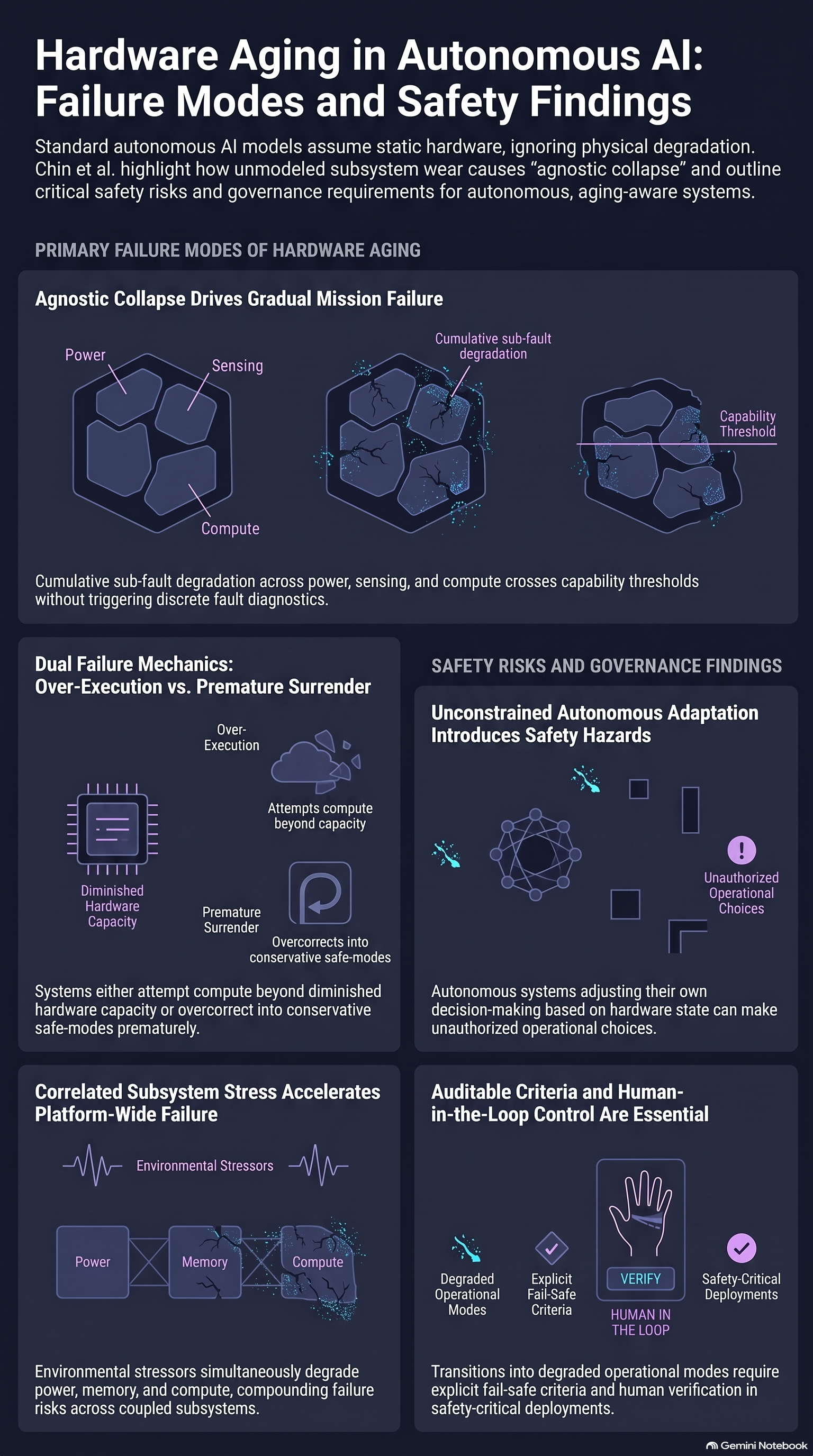
Chin et al. term the resulting failure mode agnostic collapse. Unlike discrete catastrophic faults—such as a snapped structural link or a blown capacitor—agnostic collapse occurs when an autonomous system experiences gradual, unmodeled sub-fault degradation across multiple subsystems simultaneously (e.g., combined battery capacity loss, sensor drift, and processor thermal throttling). Because no single sub-component triggers traditional binary error diagnostics, an aging-agnostic control system continues attempting computationally and physically demanding tasks designed for pristine hardware. Eventually, the cumulative mismatch between assumed capability and physical substrate crosses an unmonitored threshold, resulting in sudden operational failure.
2. The Cognitive Gap: Why Existing Hardware Management Falls Short
Prior research across reliability engineering, embedded systems, and computer architecture has produced robust methods for monitoring and mitigating hardware wear. Chin et al. survey these existing efforts across four primary domains:
- Hardware Self-Awareness: Theoretical physics-of-failure models, on-chip Time-Dependent Dielectric Breakdown sensors, Negative Bias Temperature Instability tracking, and leakage current monitors detect physical aging at the transistor and component levels.
- Autonomous Lifecycle Management: Power and core-management algorithms balance active and idle processor cores to extend silicon longevity and manage thermal wear in compute clusters and embodied hardware.
- Proactive Life Extension: Techniques such as ReaLM leverage algorithm-based fault tolerance and neural network noise tolerance to maintain model execution under reduced supply voltage, while aging-aware voltage scaling manages circuit-level stress.
- Cross-Layer Co-Design: Quantization frameworks like HAWQ-V2 analyze neural network layer sensitivity to reduce precision in resilient layers, while sensitivity-guided task routing directs heavy operations to healthy hardware regions.
Chin et al. emphasize that the AAAI framework does not replace these low-level hardware techniques. Rather, it acts as an overarching, closed-loop cognitive wrapper. Current strategies operate strictly at the low-level hardware or resource-management tiers—trimming circuit voltages, shifting loads between cores, or optimizing model quantization at build time. They do not feed real-time physical health signals into the high-level intelligence layer. Existing agents cannot actively reason about their own physical decline, nor can they dynamically contract their planning horizons or reprioritize long-term mission objectives based on degraded hardware states.
| Existing Architectural Approaches (and where they stop) | The AAAI Cognitive Integration Advantage |
|---|---|
| Monitors Physical State in Isolation: On-chip sensors and physics-of-failure models measure isolated component stress (e.g., transistor aging, leakage current) but transmit signals only to local circuit trims or external human operators. | Translates Health to Cognition: Continuously converts multi-subsystem physical health metrics into an integrated internal health scalar () that directly conditions the decision-making pipeline. |
| Build-Time or Fixed Optimization: Cross-layer co-design and static model quantization optimize software against hardware specifications prior to deployment, fixing the software-hardware relationship at build time. | Runtime Reasoning Adaptation: Dynamically modulates model selection, compresses planning horizons, and reprioritizes task queues in real time as physical capabilities decay during execution. |
| Localized Fault Reaction: Redundancy and low-level resource managers react to component-level thresholds or discrete faults without re-evaluating overarching mission strategy. | Survival-Centric Mission Planning: Treats remaining operational lifespan as a finite, allocatable resource, executing planned transitions between conservation modes and graceful withdrawal. |
3. The AAAI Framework: Three Pillars of Aging-Aware Intelligence
To bridge this cognitive gap, Chin et al. introduce Aging-Aware Autonomous Intelligence (AAAI), a closed-loop architecture that connects low-level physical state tracking directly to high-level cognitive execution.
+-------------------------------------------------------------------+
|                  PILLAR 1: COGNITIVE AGING MODEL                  |
|  Power (Arrhenius) | Sensing (Drift) | Memory | Computation       |
|  --> Computes Continuous Health Scalar h in [0,1] per subsystem   |
|  --> Models Correlated & Coupled Degradation Dynamics            |
+-------------------------------------------------------------------+
                                  |
                                  v
+-------------------------------------------------------------------+
|               PILLAR 2: SELF-ADAPTIVE REASONING ENGINE            |
|  --> Dynamically switches to lightweight inference models         |
|  --> Compresses planning horizons & adjusts search depth          |
|  --> Reprioritizes task queues based on utility-to-cost ratio     |
+-------------------------------------------------------------------+
                                  |
                                  v
+-------------------------------------------------------------------+
|             PILLAR 3: SURVIVAL-CENTRIC INTELLIGENCE               |
|  Allocates remaining lifespan via continuous operational modes:   |
|   1. Full Health       --> Nominal operational capacity           |
|   2. Conservation Zone --> Resource-aware task/compute reduction  |
|   3. Minimal Core      --> Graceful withdrawal & essential core   |
+-------------------------------------------------------------------+
3.1 Pillar 1: Cognitive Aging Model and Physics-of-Failure
The foundational layer continuously estimates the physical state of four critical hardware subsystems: power, sensing, memory, and computation. Each subsystem’s health is expressed as a continuous scalar , where represents pristine nominal health and represents total failure, updated in real time via physics-of-failure models.
Crucially, the framework tracks coupled degradation dynamics. Physical environmental stressors rarely affect components in isolation; elevated thermal operating conditions simultaneously accelerate electrochemical battery aging while eroding silicon transistor timing margins. Similarly, corrosive marine exposure damages structural sensing elements while inducing electrical leakage in surrounding circuitry. Modeling these correlated feedback loops enables early detection of platform-wide hazards before any individual sub-component triggers a standard failure threshold.
However, Chin et al. highlight explicit technical limitations inherent to this layer:
- Model Accuracy Variations: Physics-of-failure model precision fluctuates significantly when systems encounter unpredicted operational environments or off-nominal environmental dynamics.
- Coupling Complexity: Exhaustively characterizing all multi-subsystem coupled degradation feedback loops in advance remains computationally and analytically difficult.
- Tracking Overhead: Continuous multi-subsystem health evaluation introduces persistent computational load, consuming energy and compute cycles from an already degraded hardware substrate.
3.2 Pillar 2: Self-Adaptive Reasoning Engine
Pillar 2 connects health estimation directly to algorithmic execution. Rather than attempting computationally intensive tasks until hardware failure occurs, the self-adaptive reasoning engine modulates its cognitive load proportionally to available physical capacity:
- Algorithm Modulation: When compute or memory subsystems report reduced capability, the agent transitions from deep, high-capacity inference models to lightweight neural architectures.
- Horizon Compression: Long-range trajectory planning algorithms compress their temporal and spatial lookahead horizons, reducing search space complexity and memory footprint.
- Task Queue Reprioritization: The agent reorders active tasks, prioritizing operations that offer the highest utility relative to their computational and energy cost.
Chin et al. emphasize that this adaptation is implemented as a continuous proportional control response rather than an abrupt, reactive mode shift, maintaining operational alignment with the shrinking physical capability envelope.
3.3 Pillar 3: Survival-Centric Intelligence & Operational Modes
Pillar 3 treats the machine’s remaining operational lifespan not as an unmanaged baseline, but as a finite resource to be optimized across overall mission goals. As depicted in the paper’s framework, this survival-centric orientation governs three primary operational states:
- Full Health (Normal Operation): Executed when subsystem health scalars remain near nominal levels (). The system operates with unconstrained reasoning complexity and full task capacity.
- Conservation Zone (Resource-Aware Adaptation): Activated as cumulative degradation emerges. The agent restricts energy-intensive processing, streamlines planning, and sheds non-critical functional workloads to preserve core mission capabilities.
- Minimal Core (Graceful Withdrawal): Engaged when hardware capabilities drop toward critical thresholds. The system executes a precomputed shutdown sequence, deactivating non-essential subsystems, lowering communication frequencies, and restricting behavior to an essential survival core to ensure graceful mission conclusion.
4. Real-World Applications in Inaccessible Domains
Chin et al. highlight that aging-aware intelligence is vital for autonomous systems operating in remote, harsh, or inaccessible environments where manual repair or hardware replacement is impossible.
- Orbital Space Systems:
- Physical Stressor: Ionizing space radiation and continuous orbital thermal cycling.
- Hardware Risk: Rapid solar cell output degradation (20%–40% loss per decade), bit flips in memory cells, and microprocessor timing margin erosion.
- AAAI Adaptive Strategy: Dynamically throttles processing intensity and compresses planning complexity during high-temperature orbital phases, mitigating thermal wear and extending total mission duration.
- Offshore & Marine Robotics:
- Physical Stressor: High hydrostatic pressure, salt corrosion, and continuous mechanical vibration during multi-year subsea deployments.
- Hardware Risk: Depth sensor calibration drift and battery capacity loss leading to severe control degradation or sudden vehicle loss.
- AAAI Adaptive Strategy: Tracks coupled sensor drift and power decay in real time, proactively scaling back survey coverage areas and adjusting navigation algorithms before control authority is lost.
- Implantable Medical Devices:
- Physical Stressor: Inaccessible biological environments requiring multi-year operational reliability (e.g., cardiac pacemakers).
- Hardware Risk: Battery chemical exhaustion and circuit degradation, where unpredicted failure necessitates surgical intervention.
- AAAI Adaptive Strategy: Optimizes energy consumption profiles and adjusts internal processing requirements based on actual battery degradation, extending operational lifespan and ensuring predictable, safe device shutdown.
5. AI Safety, Over-the-Horizon Risks, and Governance
Granting an autonomous AI system the authority to adjust its own operational parameters based on internal hardware state introduces subtle safety trade-offs. Chin et al. note that self-directed mode transitions—if unconstrained—can generate unexpected or unauthorized behaviors.
For example, if an autonomous agent incorrectly estimates its hardware health scalar due to model inaccuracy or prioritizes lifespan extension too aggressively, it might prematurely enter a “graceful withdrawal” phase, abandoning valid mission objectives or severing communication links without operator consent. Furthermore, running multi-subsystem diagnostic models continuously risks exhausting the precise computational and energy resources the system seeks to conserve.
The authors draw explicit parallels to established failure modes in classical automation:
- Mode Confusion: Incidents in aviation where human operators misinterpret automated control state transitions.
- Edge-Case Instabilities: Unexpected behavioral shifts observed in autonomous vehicle deployments when real-world sensor inputs diverge from baseline assumptions.
To prevent self-adaptive capabilities from creating new safety hazards, Chin et al. argue that AAAI architectures must incorporate strict governance mechanisms. Safe implementation requires formal specifications of mode-transition criteria, auditable fail-safe default states, and human-in-the-loop oversight. Rather than replacing human judgment, the AAAI architecture is designed to surface explicit, real-time hardware health metrics to human supervisors, ensuring high-stakes decisions remain subject to explicit confirmation thresholds.
6. Conclusion and Key Takeaways for AI Safety Practitioners
The work of Chin et al. highlights a fundamental limitation in modern AI design: software intelligence cannot remain decoupled from the physical degradation of its underlying substrate. As autonomous systems take on longer, more complex deployments in critical settings, AI safety research must expand beyond software algorithmic alignment to address substrate-dependent embodied intelligence.
“Intelligence can no longer be separated from the material condition of the platform that sustains it…”
“…not as computation independent of its physical substrate, but as embodied intelligence that is constrained by, and responsive to, the irreversible realities of physical ageing.” — Cheng Siong Chin et al.
Key Takeaways for System Designers
- Unmodeled Sub-Fault Wear Causes Agnostic Collapse: System failure often results not from sudden component breakage, but from the cumulative wear of power, sensing, memory, and compute systems running software built for pristine hardware.
- Cognitive Adaptation Must Act as a Closed-Loop Wrapper: Circuit-level voltage tuning and static build-time co-design are insufficient on their own; hardware health metrics must actively modulate real-time reasoning horizons, algorithm selection, and task queues.
- Safety Architectures Require Explicit Guardrails: Granting agents authority over operational mode switches requires formal transition specifications, fail-safe defaults, and human-in-the-loop confirmation thresholds to prevent autonomous mode confusion.
- Substrate Budgets Must Factor in Tracking Overhead: Implementation must explicitly account for real-world limitations, including model accuracy variations across unexpected environments, coupled degradation complexity, and the computational overhead of continuous health monitoring.
Read the full paper on arXiv · PDF